
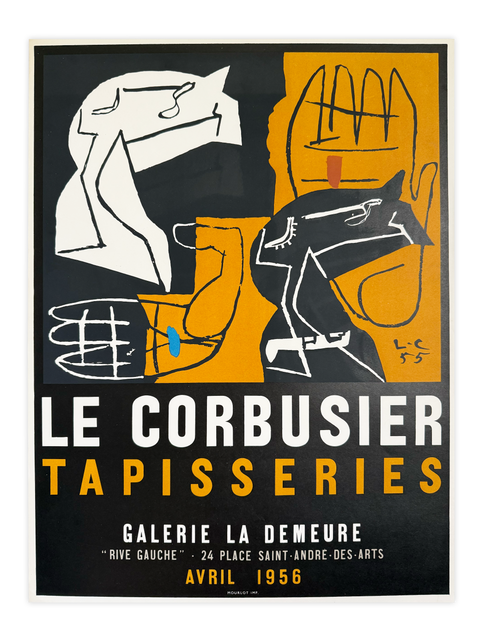
Original Le Corbusier Poster "Tapisseries" 1956 - Mourlot
by nbmposter
Regular price$2,775.00 Sale pricePickup currently unavailable

| Artist | Le Corbusier |
| Year | 1956 |
| Exhibition | Tapisseries — Galerie La Demeure, Paris |
| Printer | Mourlot Frères, Paris |
| Size | 49 × 65 cm (19.25 × 25.5 in) |
| Type | Original vintage lithographic exhibition poster |
| Condition | A- — Overall Good |
This is an original lithographic poster created in 1956 by Le Corbusier and printed by Mourlot Frères for an exhibition of his tapestries at the Galerie La Demeure in Paris — one of the most significant presentations of a dimension of his work that remains, even today, largely overlooked by those who know him only as an architect. The tapestries exhibited here were Gobelins — works produced at the legendary Manufacture Nationale des Gobelins — translating Le Corbusier's visual language into textile with the same rigour and chromatic intensity he brought to everything he touched.
Le Corbusier (1887–1965), born Charles-Édouard Jeanneret-Gris in La Chaux-de-Fonds, Switzerland, is universally recognised as the most influential architect of the 20th century — the creator of the Villa Savoye, the Unité d'Habitation in Marseille, the Chapel of Notre-Dame-du-Haut at Ronchamp, and the master plan for Chandigarh. But from 1918, when he met the Cubist painter Amédée Ozenfant, Le Corbusier was also a painter, a draughtsman and, in his later career, a designer of tapestries — a medium he embraced with the same passion for geometric form, primary colour and spatial composition that defined his buildings. He called his tapestries his "murals nomades" — nomadic walls — works of art that could travel where architecture could not.
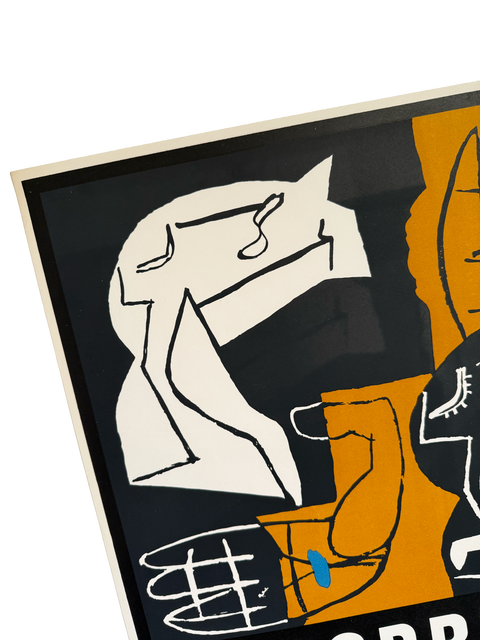
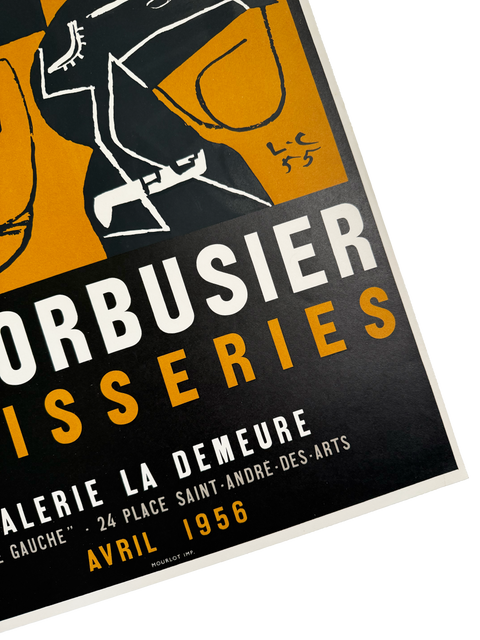
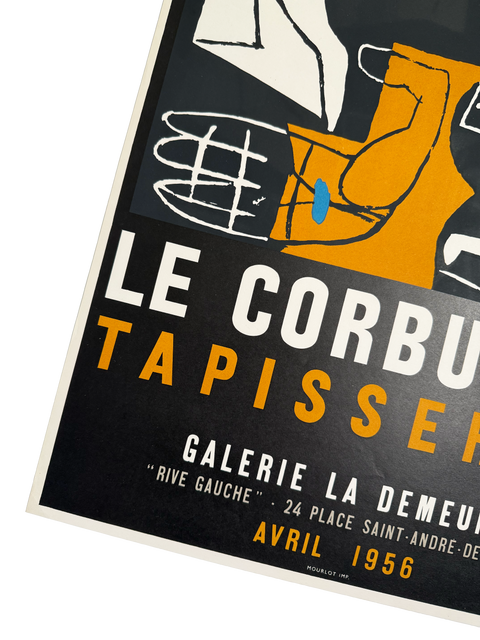
The Galerie La Demeure was one of the most respected spaces in Paris for the intersection of art, craft and interior design — a natural home for Le Corbusier's tapestries, which occupied precisely that territory between fine art and the applied arts. Printed by Mourlot Frères, the poster is itself a graphic work of the highest order: bold, geometric, composed with the economy that defined Le Corbusier's entire visual language.
The poster is in overall good condition — grade A- — and is presented unframed, ready for the wall it deserves.
A rare and distinguished piece — Le Corbusier as visual artist, his nomadic walls, at the gallery that understood them best.