
Original Pablo Picasso Poster "Dessins" 1954 - Mourlot
par nbmposter
Prix régulier$720.00 Prix de soldeRécupération sur place actuellement non disponible
| Artist | Pablo Picasso |
| Year | 1954 |
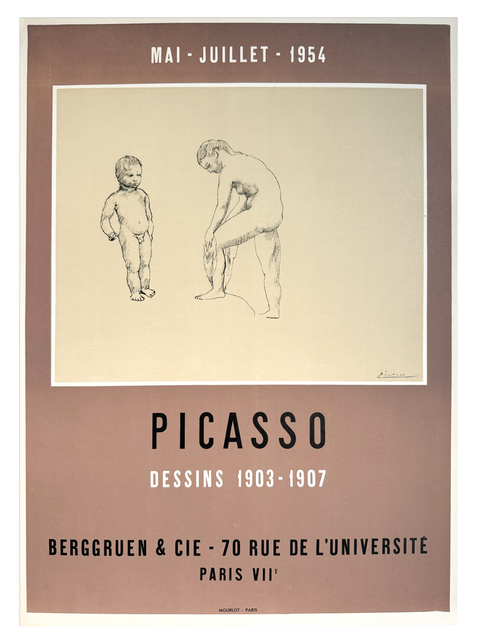
| Exhibition | Picasso Dessins 1903–1907 — Galerie Berggruen & Cie, 70 rue de l'Université, Paris (May–July 1954) |
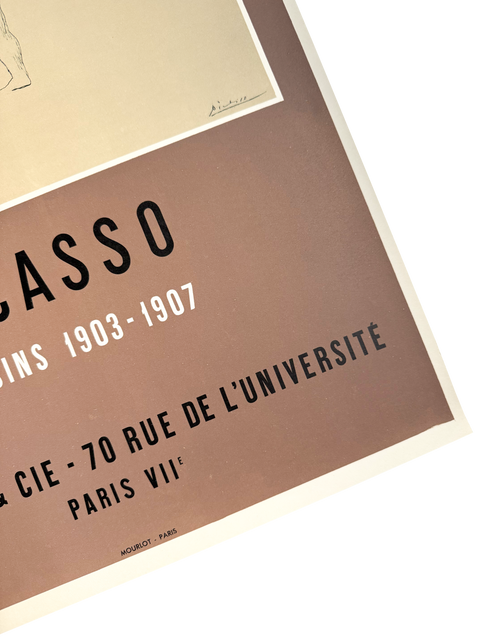
| Printer | Mourlot Frères, Paris |
| Reference | Czwiklitzer n° 95 |
| Size | 49 × 67 cm (19.3 × 26.5 in) |
| Type | Original vintage lithographic exhibition poster |
| Condition | A — Good condition |
This is an original lithographic poster printed by Mourlot Frères for the exhibition Picasso Dessins 1903–1907 at the Galerie Berggruen & Cie in Paris — held from May to July 1954 at the gallery's address on the rue de l'Université, with a catalogue introduction written by Daniel-Henry Kahnweiler, Picasso's most trusted dealer and the man who had first championed Cubism to the world. The show was dedicated to one of the most decisive periods in the history of modern art: the years between 1903 and 1907 in which Picasso moved from the tender melancholy of his Blue and Rose periods through the proto-Cubist distortions of the Iberian figures toward the founding rupture of Les Demoiselles d'Avignon. The image on this poster — a mother and child drawn in 1906 — captures the brief, luminous threshold between those two worlds: the figure still recognisably human, the line already hardening toward something new.
Pablo Picasso (1881–1973) arrived in Paris for the final time in 1904, settling in the Bateau-Lavoir in Montmartre and working in conditions of extreme poverty that his later fame would make almost mythological. The drawings from this period — quick, searching, executed in pencil, ink, pastel and gouache — are among the most intimate and revealing works he ever made: private documents of a young artist discovering his powers, finding his subjects, moving with extraordinary speed from style to style. By 1907, with the completion of Les Demoiselles d'Avignon, he had permanently changed the course of Western art. This exhibition, mounted fifty years after those drawings were made, was the first major attempt to survey them as a coherent body of work.
The Galerie Berggruen on the rue de l'Université was the ideal setting. Heinz Berggruen — dealer, collector and friend of Picasso — had built the most focused and discerning private collection of Picasso's work in Europe, and his gallery was a space defined by the direct transmission of artistic values from artist to collector. A catalogue introduced by Kahnweiler, printed by Mourlot, for a show curated by Berggruen — this is Picasso's inner circle at its most concentrated.
This example is in good condition — grade A — and is presented unframed, ready for the wall it deserves.
A rare document of a pivotal moment — Picasso before Cubism, at the gallery that understood him best, introduced by the dealer who championed him first.

Certificate of Provenance
Your certificate — unique to your piece — is included with every purchase and shipped alongside your artwork.