
Récupération sur place actuellement non disponible
| Artist | Jean Dubuffet |
| Year | 1967 |
| Gallery | Galerie Jeanne Bucher, Paris |
| Size | 37 × 57 cm (14.5 × 22.25 in) |
| Type | Original vintage die-cut lithographic poster — cut to the shape of the composition |
| Condition | A — Good condition, see pictures |
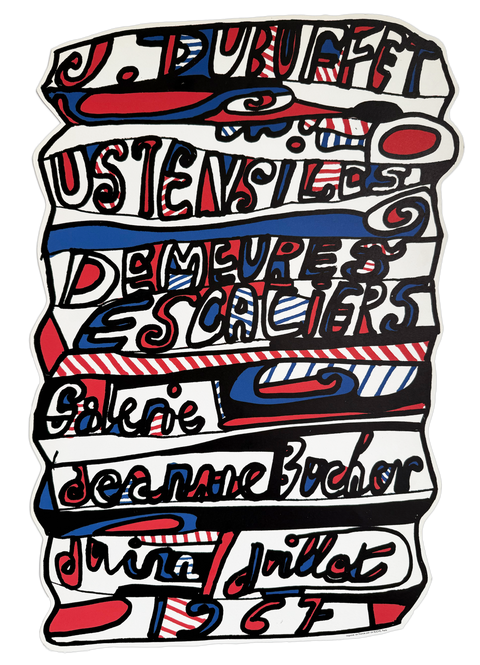
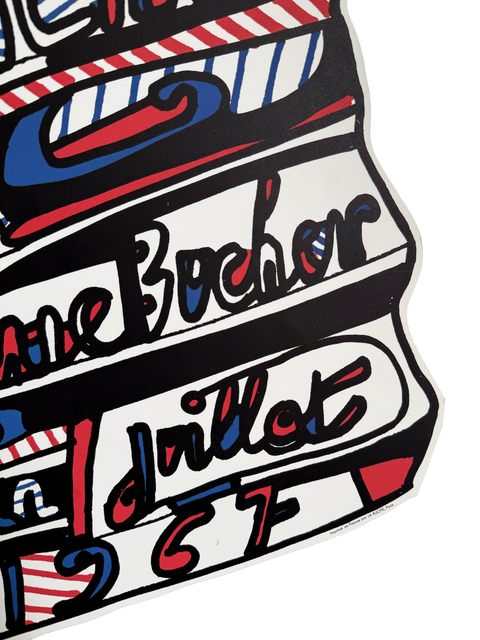
This is an original die-cut lithographic poster created in 1967 by Jean Dubuffet for an exhibition at the Galerie Jeanne Bucher in Paris — and it is immediately unlike anything else: the poster has been cut to follow the outline of Dubuffet's own composition rather than trimmed to a standard rectangular format. This die-cut process — in which the printed sheet is shaped to the contours of the image itself — was extraordinarily rare in poster production of this period, and entirely in keeping with Dubuffet's refusal of convention at every level. The result is an object that functions simultaneously as exhibition announcement, multiple, and sculptural form.
Jean Dubuffet (1901–1985), born in Le Havre, was one of the most radical and uncompromising figures in the history of 20th-century art — the inventor of Art Brut, the tireless champion of creativity outside the academy and the mainstream, and one of the most formally inventive artists of the post-war period. By 1967, he was fully immersed in his celebrated L'Hourloupe cycle — the long, sprawling body of work he had begun in 1962 and would continue until 1974, characterised by interlocking cell-like forms drawn in blue and red on white, building up into figures, landscapes, architectural environments and finally entire inhabitable worlds. The cycle took its name from a word Dubuffet invented — evoking both the French for "howl" and a nonsense fairy-tale creature — and it is among the most sustained and original artistic enterprises of the 20th century.
The Galerie Jeanne Bucher on the Boulevard du Montparnasse was one of the oldest and most distinguished galleries in Paris — founded in 1925, it had shown Kandinsky, Klee, Masson and Giacometti before becoming one of Dubuffet's regular Paris venues. A die-cut exhibition poster for a show at Bucher in the heart of the Hourloupe years is a document of Dubuffet at the peak of his formal invention — and a piece whose own physical form enacts exactly the values it represents.
This example is in good condition — grade A — and is presented unframed, ready for the wall it deserves.
A singular object — Dubuffet's most celebrated cycle, in a poster that refuses even the rectangle, from the gallery that understood him best.

Certificate of Provenance
Your certificate — unique to your piece — is included with every purchase and shipped alongside your artwork.